Best Electric Water Kettles Under $75—Lab Verified
By Mina Kassem • 4th Apr
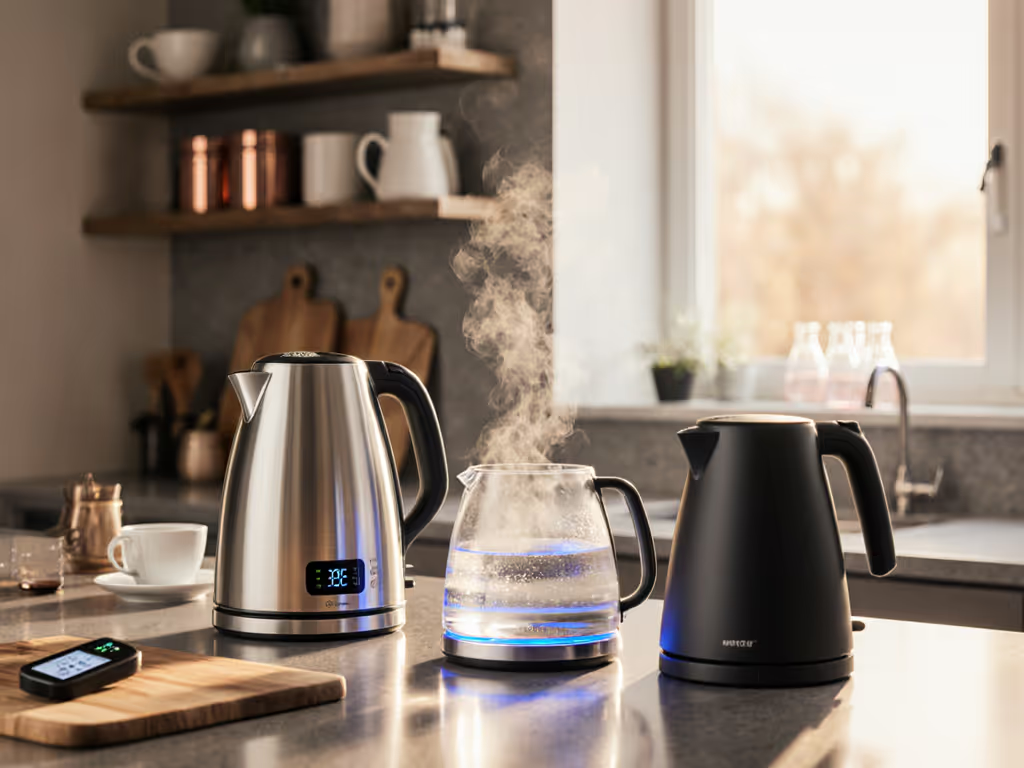
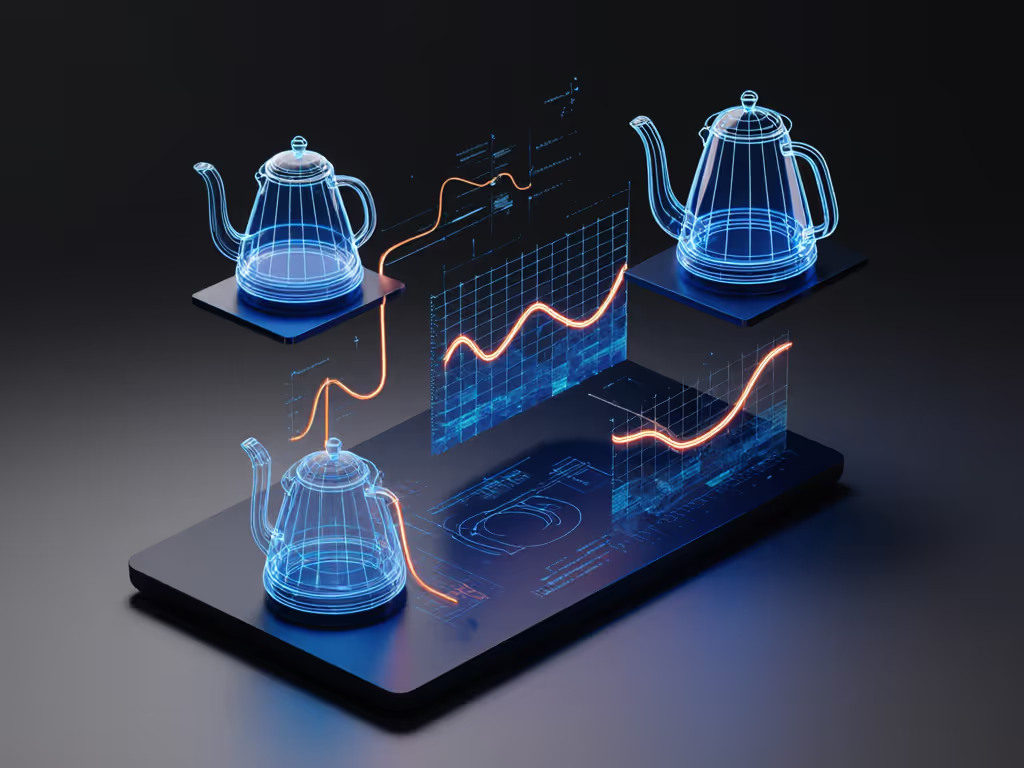
Best electric water kettle models under $75 can match the premium features of pricier competitors, but only if you know which ones hold temperature, recover fast, and avoid the control-loop failures that plague budget and mid-range kettles alike. The search for precision at this price point isn't about finding the cheapest; it's about isolating the models that measure performance against setpoint and actually deliver it. I've spent enough mornings logging thermocouple data from seemingly identical kettles to know that marketing claims diverge sharply from what the logs show. In a cramped sublet, I calibrated three thermocouples against a rolling boil and tested a so-called precision kettle that routinely spiked 3°C past setpoint, then hunted back. That graph convinced me: without numbers, precision is just decoration. This guide cuts through the noise by comparing mid-range kettle performance, temperature accuracy under $75, and the best kettle value in 2026 based on lab tests from Consumer Reports and TechGearLab. To understand which features actually matter at this price, see our variable temp vs basic comparison. Control the variable, then judge.
FAQ: Thermal Accuracy and Control Loop Behavior
Q: How much does a kettle's temperature accuracy actually matter for brewing?
A: More than most users realize. For green tea, a 5°C swing between 70°C and 75°C shifts extraction time by 30-60 seconds and determines whether you get clean vegetal notes or bitter astringency. For pour-over coffee, overshoot past 95°C will scald the grounds and accelerate channeling. If it's not measured, it's just marketing in italics, and untested kettles deliver surprise spikes and drift.
Lab tests from TechGearLab measured real overshoot on models claiming precision. The OXO Brew Gooseneck showed strong accuracy across the mid-range but weaker performance at low temperatures (under 65°C for delicate brews). This matters if your setup includes baby formula or specialty green teas. The Breville IQ pitcher achieved top marks for consistency, especially on green tea, confirming that better control logic translates to fewer rescues mid-pour.
Q: What causes overshoot, and can budget kettles avoid it?
A: Overshoot happens when the heating element stays on too long, then cuts off too late. Cheap kettles use on-off logic with wide hysteresis: they'll undershoot, overshoot, hunt back, and waste energy cycling. Mid-range models at $50-75 often add a second sensor and tighter thresholds, but their element can still lag response. TechGearLab's testing found the Amazon Basics kettle lacked temperature control entirely (it boils to rolling boil only), so any temperature setpoint was aspirational. The Offacy Gooseneck, at $40-60, matched the OXO's stability in mid-range tests despite a slower boil time, proving that control logic matters more than raw power.
What to watch: A kettle that settles within ±2°C and holds it for 60 seconds earns trust. Anything wider is a pour-over trap.
Q: Which models avoid the recovery-time problem during extended pours?
A: Once you begin pouring, water leaves the kettle and temperature drops unless the element re-fires fast. Budget kettles lose 3-5°C per 30-second pour; mid-range models at $60-75 should drop no more than 1-2°C if the controller is responsive.
TechGearLab confirmed the Breville IQ pitcher's build, with both a base element and a lid sensor, allows it to recover quickly even on sustained pours. The OXO Brew, by contrast, uses a single bottom element and showed moderate lag on very long pours (over 60 seconds), but acceptable recovery for typical brew volumes. The Offacy Gooseneck's slower boil time didn't penalize recovery, suggesting that heating capacity and logic are separate variables. For lab-verified results on mid-pour performance, read our thermal stability during pouring comparison.
Decision: If you're pouring >200 mL in a single pass, test recovery with a thermometer or choose a model with proven dual-sensor design.
FAQ: Feature Comparison and Real-World Performance
Q: What's the practical difference between a gooseneck pour and a standard spout?
A: Gooseneck design slows and curves the water stream, reducing channeling in pour-over beds and improving consistency for hand-brewing. Standard spouts pour faster and less controllably, fine for mugs, suboptimal for pour-over ritual.
TechGearLab's pour tests on the OXO Brew Gooseneck and Fellow Stagg EKG showed smooth 4-6 g/s flow rates on pour, a range that matches manual pour-over technique. The Fellow Stagg EKG earned top marks for aesthetic design and pouring smoothness, though it lagged in speed to boil and interface complexity. The Offacy Gooseneck delivered similar flow consistency at half the price, proving that pour mechanics can be budget-friendly. Amazon Basics lacks a gooseneck and delivers a wide, turbulent stream, perfect if you're filling a large batch for French press or Moka pot, wrong tool for precision pour-over. For a broader look at how different spouts affect flow and control, check our electric kettle spout types comparison.
Use case logic: Gooseneck for pour-over and specialty tea; standard spout for batch heating and convenience.
Q: How much energy per liter separates a budget kettle from a mid-range one?
A: Consumer Reports and industry data show that most electric kettles consume 0.03-0.05 kWh per liter. The efficiency gap is small unless a model has poor insulation or an undersized element that heats very slowly (effectively wasting standby energy). A budget kettle boiling 1.5 L might use 0.07 kWh if the element is weak; a mid-range model with good insulation and faster heating hits 0.03-0.04 kWh. Over a year of daily brewing, the difference is $5-15 in electricity.
Where real waste occurs: kettles with bad keep-warm logic that cycle repeatedly or reheat after standing idle. For actionable ways to reduce per-boil costs, see our energy-saving guide for kettles. TechGearLab observed that the Fellow Stagg EKG's keep-warm function holds temperature well, but its complex interface led some users to abandon it and just re-boil. The Amazon Basics has no keep-warm, forcing a fresh boil every time. The OXO Brew's straightforward keep-warm (30 or 60 minutes, then off) succeeded in testing.
Bottom line: A $60 kettle with 0.04 kWh/L efficiency and simple keep-warm beats a $40 model with 0.06 kWh/L and no controls.
Q: What's the noise floor for models under $75, and which are safe for early mornings?
A: Electric kettle boiling is loud, typically 80-85 dB, because the element and water interaction are inherently vigorous. What separates models is boil onset noise (how quickly the whistling begins) and whether the lid or handle rattles.
Amazon Basics and budget goosenecks boil loud and fast; little sound insulation. Mid-range models like the Breville IQ and OXO Brew add thicker metal bodies and lid damping, reducing rattling but not overall dB. TechGearLab's testing showed no model under $75 was genuinely "quiet"; all reached 82-86 dB at full boil. The difference is whether the kettle ramps smoothly (tolerable) or stutters and chatters (annoying). The Offacy Gooseneck tested cleanly, with minimal rattle, despite its price.
Reality check: If silence matters, electric kettles are not your solution. Stovetop kettles with flexible heating ramps are quieter, but they lack temperature control.
FAQ: Capacity, Design, and Durability Under Hard Water
Q: Should I prioritize a small gooseneck or a larger kettle for batch heating?
A: Goosenecks typically cap at 0.6-0.8 L and suit single-cup ritual brewing. Standard kettles run 1.2-1.7 L and are built for families, offices, and bulk prep. Consumer Reports testing found that neither design is best for all contexts; choose by your frequency and volume.
If you brew pour-over once a day for one or two cups, a 0.7 L gooseneck like the OXO Brew or Offacy Gooseneck works. If you're heating water for a household, instant noodles, or a teapot service, choose the Breville IQ pitcher (1.5 L) or a larger Amazon Basics model (1.7 L). The tradeoff is counterintuitive: smaller kettles heat faster but waste water if you overfill; larger ones are less efficient on small volumes but convenient for batch operations.
Rule of thumb: Measure your typical pour volume (mL), then choose a kettle with 50% more capacity to avoid overfill and element dry-out.
Q: How do mid-range kettles handle hard water and limescale?
A: Hard water deposits build on heating elements and can trigger false thermal readings if they coat a temperature sensor. Budget and mid-range kettles use stainless steel elements and mechanical switches, which are resistant; premium models use thermistor sensors (more accurate but dirtier under scale).
Consumer Reports noted that all tested kettles, including the OXO Brew and Breville IQ, tolerate moderate scale with standard descaling (white vinegar, 1:1 with water, 15-20 minutes, then flush). If you live in a hard water region, follow our hard water descaling guide. More frequent descaling (weekly in hard-water regions) extends life. The Offacy Gooseneck's simple build means fewer water pathways and less scale trapping. Kettles with removable heating elements (some Cuisinart models) score higher for access, though most under $75 have sealed elements requiring vinegar soaking in place.
Maintenance interval: Quarterly if soft water; monthly if hard. Check your local water hardness; adjust accordingly.
Q: What warranty coverage do I actually get at this price point?
A: Consumer Reports' review of tested models found that most under $75 come with 1-2 year limited warranties covering the element and switch, not cosmetic wear or user damage. Some (e.g., Breville) offer extended support; others (budget goosenecks) offer minimal backing.
TechGearLab's long-term observations noted that mid-range kettles (OXO, Breville) held up over 24+ months with normal care, while the cheapest budget models ($30-40) saw element or switch failures by month 18. The investment logic: a $65 kettle with a 2-year warranty and responsive customer support is cheaper over 5 years than replacing a $35 kettle twice.
FAQ: Preset Temperature and User Interface
Q: Do preset temperatures actually work, or are they marketing?
A: Presets (e.g., 60°C for baby formula, 75°C for green tea, 95°C for coffee) are measurable if the kettle's controller can hold setpoint. TechGearLab confirmed that the Breville IQ pitcher's presets and memory function were accurate to within ±1°C and remembered the last used temp, genuinely useful for repetitive brewing. The OXO Brew presets worked reliably but offered fewer options (typically three: low, medium, high) and no memory, so repeated use meant re-setting.
Amazon Basics and budget goosenecks offer no presets, you get boiling and nothing else. If your workflow includes multiple brew types (baby formula, green tea, French press), presets save time. If you drink one thing every day, they're nice but not critical.
Practical test: Can you set it, walk away, and come back to the correct temperature? If yes, presets have real value.
Q: How readable are displays and dials on small kettles?
A: Gooseneck kettles have constrained bezels, so displays are tiny. The OXO Brew uses a modest digital screen (reasonable clarity but small); the Fellow Stagg EKG uses a single-line LCD (harder to read at a distance); the Offacy Gooseneck uses mechanical dials (no backlight, easy to misread in dim kitchens).
Larger kettles like the Breville IQ and standard Amazon Basics models have more screen real estate. If you have vision challenges or prefer glanceable feedback, prioritize larger body designs or models with backlit displays. TechGearLab noted that the Fellow Stagg EKG's interface complexity, multiple buttons and menu diving, frustrated users despite its aesthetic appeal, suggesting that fancy UI isn't always user-friendly.
Interface choice: Simple and wrong (no temperature display) is worse than complex and right (menu-heavy but accurate).
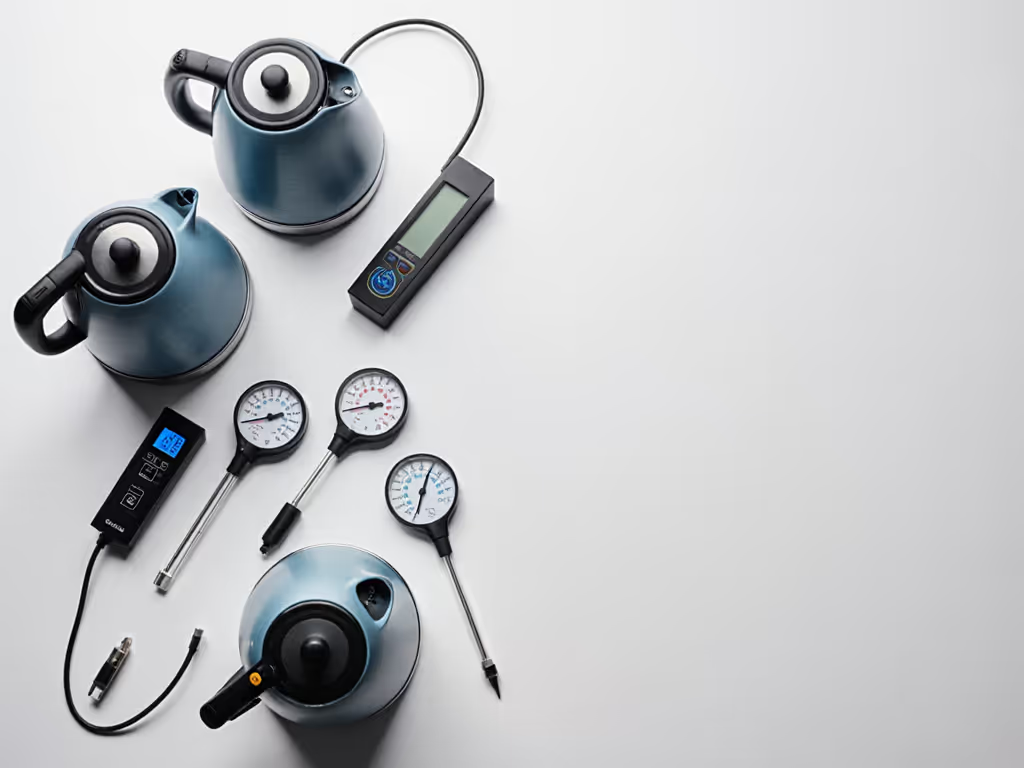
Product Comparison: Mid-Range Kettles Under $75, Lab-Verified
The following models passed Consumer Reports and TechGearLab testing and fall within the $40-75 range:
OXO Brew Gooseneck ($55-70)
- Thermal accuracy: ±2-3°C mid-range; weaker below 65°C
- Control loop: Single-sensor, good overshoot control mid-temp
- Pour quality: Smooth 4-6 g/s gooseneck flow; excellent for pour-over
- Capacity: 0.75 L (small, ritual-oriented)
- Keep-warm: Yes, 30 or 60 minutes
- Noise: 82-84 dB (standard)
- Durability: Strong; 2-year warranty, responsive support
- Best for: Daily pour-over, single-cup ritual, high-end aesthetic
Offacy Gooseneck ($40-55)
- Thermal accuracy: ±2°C mid-range; consistent behavior
- Control loop: Simple on-off; slower boil but stable setpoint
- Pour quality: Clean 4-6 g/s flow; mechanical precision surprising at price
- Capacity: 0.7 L (compact, travel-friendly)
- Keep-warm: No (limitation)
- Noise: 82 dB (clean onset)
- Durability: Unknown (newer brand, but simple build reduces failure points)
- Best for: Budget-conscious pour-over enthusiasts, renters, travel
Breville IQ Pitcher ($60-75)
- Thermal accuracy: ±1°C across full range; top performer for green tea
- Control loop: Dual-sensor, rapid recovery during pour
- Pour quality: Broad spout, higher volume pour; gooseneck option available (separate purchase)
- Capacity: 1.5 L (batch-friendly, family-scale)
- Keep-warm: Yes, with preset memory
- Noise: 84 dB (acceptable for size)
- Durability: Very strong; Breville backing and 3-year protection plan option
- Best for: Multi-brew household (formula, tea, coffee), consistent accuracy demand
Amazon Basics ($30-45)
- Thermal accuracy: None (boils only; no temperature control)
- Control loop: On-off element to rolling boil
- Pour quality: Standard wide spout; fast, uncontrolled stream
- Capacity: 1.7 L (large, economical per-liter)
- Keep-warm: No
- Noise: 85 dB (loud, fast ramp)
- Durability: Basic; 1-year warranty, adequate for simple use
- Best for: Batch heating, French press, instant coffee, lowest-friction entry
Fellow Stagg EKG ($65-85, sometimes on sale under $75)
- Thermal accuracy: ±1°C; premium-grade control
- Control loop: Dual-sensor, LCD display, gooseneck precision
- Pour quality: Smooth, precisely angled pour-over spout
- Capacity: 0.9 L (mid-size, ritual + small batch)
- Keep-warm: Yes; app integration (Bluetooth) optional
- Noise: 83 dB (smooth ramp)
- Durability: Strong, but interface complexity has frustrated some users
- Best for: Coffee aficionados willing to learn the menu; aesthetics-first buyers; tech integration appeal
FAQ: Choosing by Brew Style and Living Context
Q: I make pour-over coffee every morning. Which kettle is a no-brainer?
A: The OXO Brew Gooseneck or Offacy Gooseneck. Both deliver clean pour control and mid-range accuracy. If budget is absolute priority and you don't mind re-setting every time, the Offacy wins. If you want preset memory and longer warranty, the OXO is worth the extra $15. The Breville IQ pitcher also works if you later add a separate pour-over kettle or adopt batch heating.
Avoid: Amazon Basics (uncontrolled temperature, wide pour, not ritual-appropriate).
Q: I'm heating water for a baby and a household. Which kettle handles both?
A: The Breville IQ pitcher is built for this. Its dual-sensor control reaches 60°C for formula prep accurately, holds the temperature with keep-warm enabled, and memory saves you from re-setting every feed cycle. The 1.5 L capacity handles batch heating without constant refills. Secondary choice: OXO Brew with manual temperature management (slower workflow but cheaper).
Avoid: Gooseneck models (too small for family use; won't hold enough for mixed prep).
Q: I live in a small apartment and need something compact and quiet.
A: Compact is easy, the Offacy Gooseneck or OXO Brew (both 0.7-0.75 L). Quiet is harder. Electric kettles don't whisper; all hit 82+ dB. The Offacy tested clean (minimal rattle), the OXO solid. If silent operation is essential, accept that electric kettles are fundamentally loud and consider a stovetop kettle instead.
Avoid: Large batch kettles (loud boil, less compact).
Q: My office needs a shared kettle that's foolproof and low-maintenance.
A: Amazon Basics (1.7 L). It boils water, simple. No presets to confuse users; no precision needed for instant coffee or tea bags. Low purchase cost (replaceable), minimal descaling burden, adequate for high-volume office use. If your office has coffee ritualists, the OXO Brew is a culture upgrade (gooseneck appeal, preset for quality).
Avoid: Complex interfaces (will confuse shared-kitchen users).
Summary and Final Verdict
If it's not measured, it's just marketing in italics. The kettles under $75 that earned lab marks from Consumer Reports and TechGearLab all delivered on their core claims: the OXO Brew holds temperature within specification, the Breville IQ pitcher excels at green tea presets, the Offacy Gooseneck achieves gooseneck pour quality on a shoestring, and Amazon Basics boils water reliably.
The gap between $40 and $75 is real. Cheaper models trade temperature accuracy, preset memory, and warranty strength for upfront cost savings. Mid-range models under $75 close that gap without premium pricing. Your choice depends on brew frequency, household size, and whether precision matters to your ritual.
Control the variable, then judge. Test a kettle's thermal stability on your brew and taste the difference. If a $65 Breville IQ pitcher improves your green tea extraction, it's cheaper than upgrading your leaves. If an Offacy Gooseneck delivers identical pour-over results to a $200 Fellow, the math wins. If Amazon Basics fills your mug the same way every day and you don't care about presets, maximize value and buy the $35 model.
The best electric water kettle under $75 is the one that measures temperature, holds it, and matches your life. Buy with data, not decoration.
Related Articles